
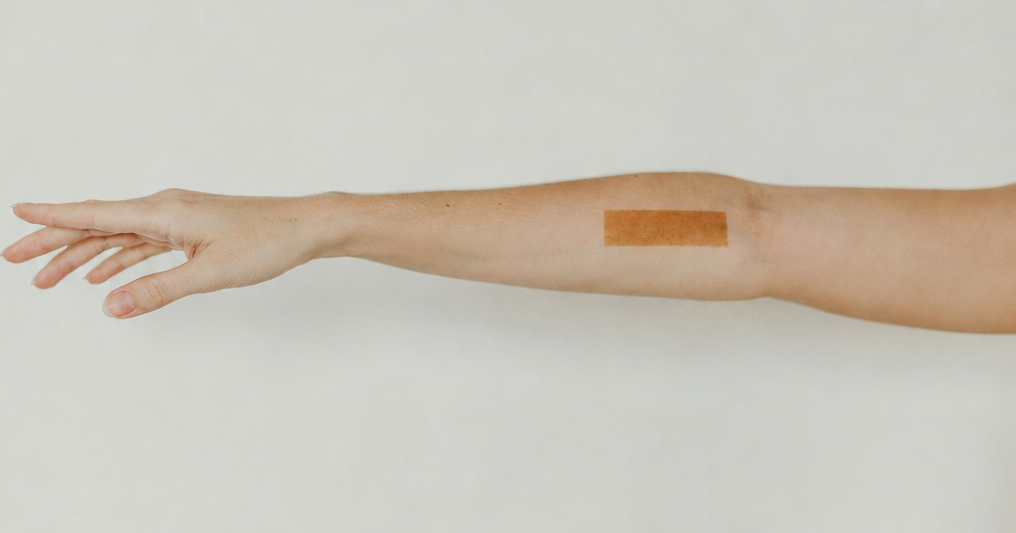
The iodine patch test is telling you about the weather, not your iodine.
You may have heard of the iodine patch test, paint a 5cm square of Lugol’s on the forearm and watch how quickly it fades. The theory is that rapid fading signals iodine deficiency and vise versa, if the yellow color lingers, the more sufficient in iodine the person.
The reality is that roughly 88% of iodine applied to our skin evaporates into the air within the first hour of application. The speed at which the colour disappears is dictated far more by temperature, humidity, and atmospheric pressure than by your iodine levels. Within the first minute, the losses of iodine by evaporation are 10-15% at 9° C; 18-25% at 24° C; and 35% at 37° C. It tells you more about the weather than your body.
The iodine skin patch test is one of those health myths that sounds incredibly convincing.
Paint a square of iodine on your arm. If it vanishes quickly, you’re supposedly deficient.
Simple. Visual. Slightly magical. And that’s exactly why it became so popular.
The idea gained traction in natural health circles decades ago, based on a reasonable-sounding theory: if the body needs iodine, it will absorb more through the skin. The problem? That’s not actually what the patch is measuring.
Researchers eventually showed that the brown stain fades largely because iodine evaporates fast, and this is impacted by humidity, atmospheric pressure and temperature, not because your body is secretly vacuuming up iodine according to its deficiency status.
Even Dr Guy Abraham, one of the pioneers of modern iodine therapy, acknowledged that the skin patch test was not a reliable way to assess iodine sufficiency. But we humans are deeply reassured by things we can see and the good old patch test gives us a visible result and it feels like your body just sent you a diagnostic report.
Molecular Iodine has strong affinity with lipids and applying topically with an oil base to anchor it to the skin as we’ve created with our InnerKin roller, prevents this rapid escapism. This doesn’t mean it gives greater accuracy for diagnostic purposes, but it does allow for maximum topical iodine penetration.
The only reliable way to assess your iodine status is a 24-hour urine iodine loading test, ordered through a naturopath or integrative GP. That’s the number worth knowing.


0 Comments